

From an artistic perspective I have to ask myself, “What really do I want to do with geometric shapes?” I can appreciate the purity of the shapes, and enjoy re-creating these shapes with a compass and protractor. But, right there, the word ‘re-create’ doesn’t feel right to me. I want to be inventive, not re-creative. Understanding underlying geometric shapes by observing a flower is beneficial. It would aid in painting a flower. Maybe I should lightly sketch the geometric shape before developing it with paint. I think that would help with accurately representing the flower, even if I abstracted it from there. Lastly, as ‘Sacred Geometry’ I think I would like to explore geometric shapes for their spiritual significance and symbolic meanings. I like this idea. It adds dimension and meaning to the work. It also benefits me while I meditatively paint. I’m going to keep these ideas in mind going forward.
One thing is for sure. If I don’t continue my ongoing practice of geometry, I will quickly lose everything I’ve recently learned. This is why questioning what I’m doing is important. My takeaway is that I will do my best to keep up my practice.
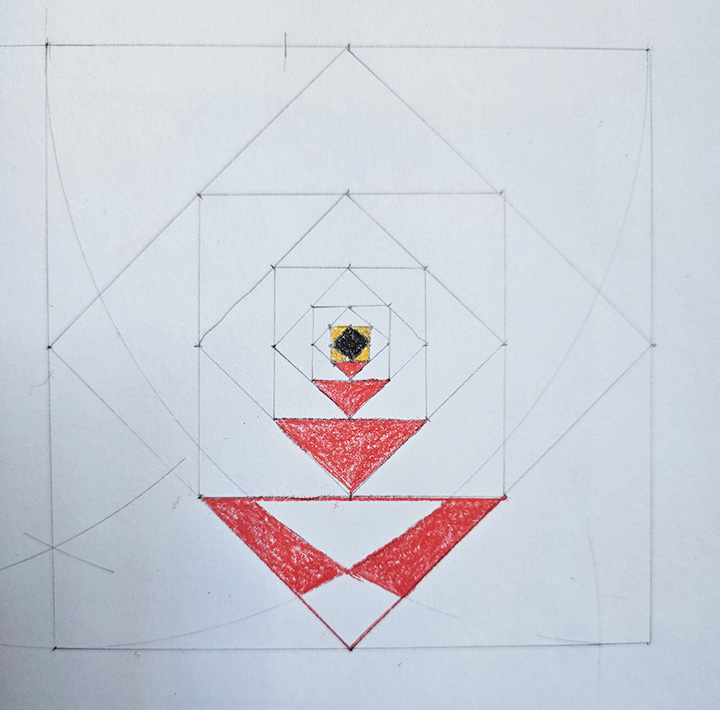
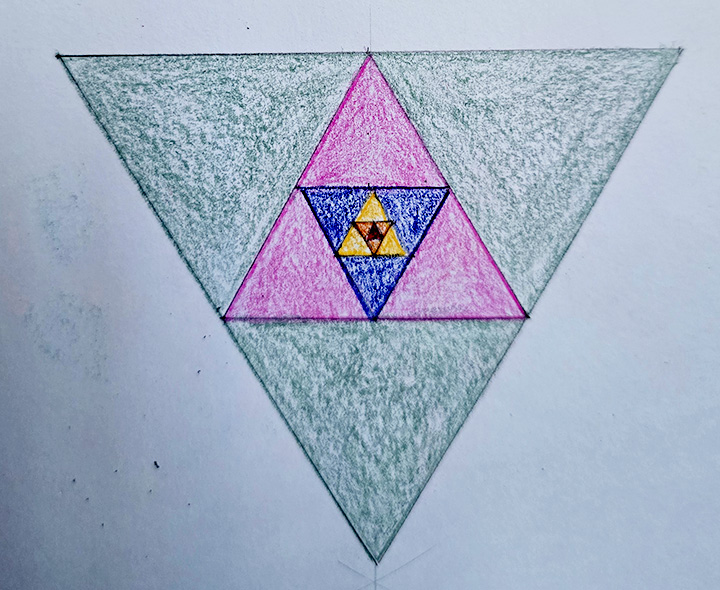
In class we drew triangles within triangles and squares within squares. Then we basically offset the geometric progression and formed a spiraling effect.
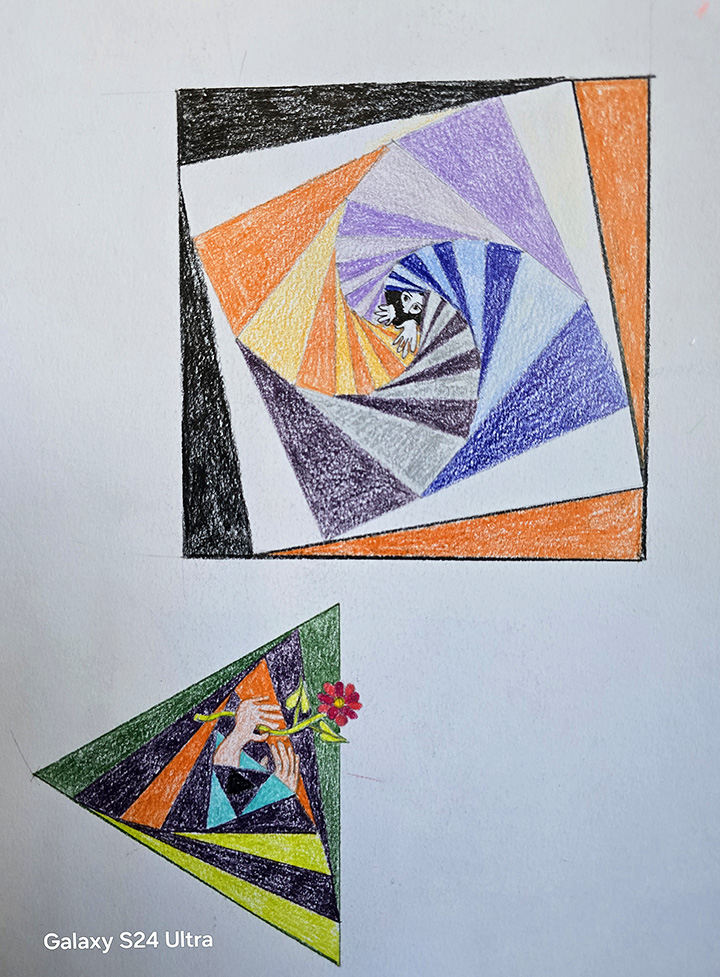
I added the figures in the middle to enhance the vertigo feeling that these spirals suggest. I used Prismacolor Pencils for the above four drawings. Prismacolor comes in a wide range of colors and you can achieve great intensity depending on the pressure you apply. I’ve always liked Prismacolor Pencils for brief mock ups.
I thought doing some shapes in black and white would be dramatic, and maybe switching mediums. Then my NEON brain cell turned on! Usually, I incorporate neon with other types of painting materials. With this final piece I chose to use, out-of-the-jar phosphorescent paint by NOVA brand paint supply.
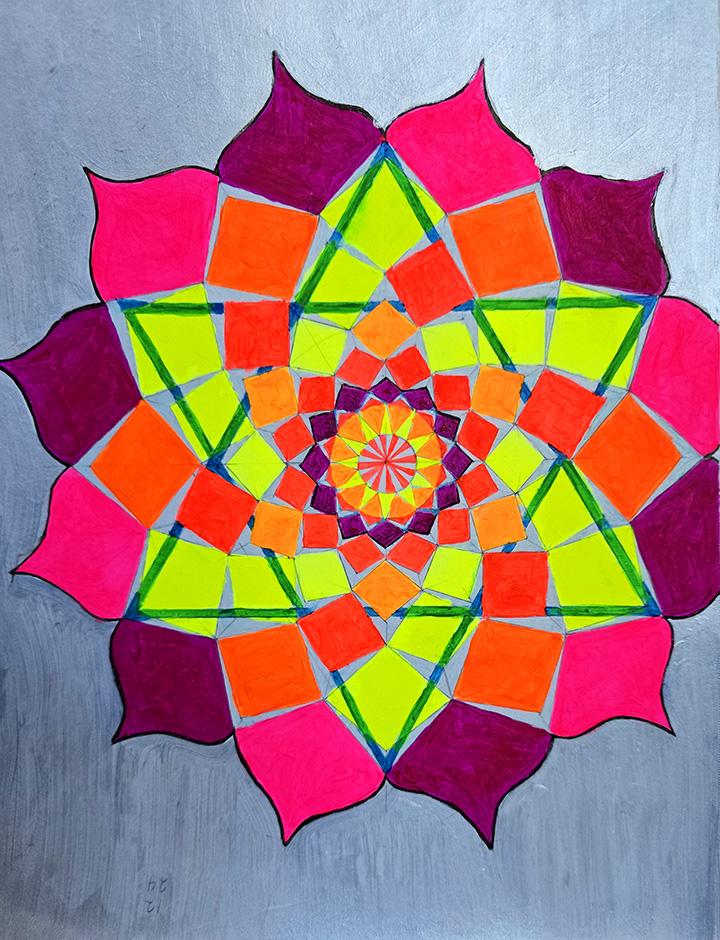
By staggering the color of the shapes I achieved a pin wheel effect. It turned out great just seeing it under lack light. But, if you can look at this next image through 3D glasses, it becomes magical.

I wish there was a way to easily and cheaply photograph 3D paintings. I sure don’t know how. If you have a pair of cardboard 3D glasses try looking at my image.
Thus concludes my geometry play session for the week.
 susan krieg
Kaleidoscope! I so admire your talent!
Carol Forster – Sent from my iPhone
carol.forster@hotmail.com
LikeLike
Great explanation of your dive into “Geometric Abstraction”. I understand about the illusion of 3-D painting. Look up “Richard Soros”. His work is incredible and with 3-D glasses they become magical. I’m created a few organic abstraction pieces which incorporate the principle and elements of design. Because of knowing Richard and viewing his originals, I’ve begun to try and incorporate some of that magic in my organic abstractions, which I seldomly create.
LikeLike