
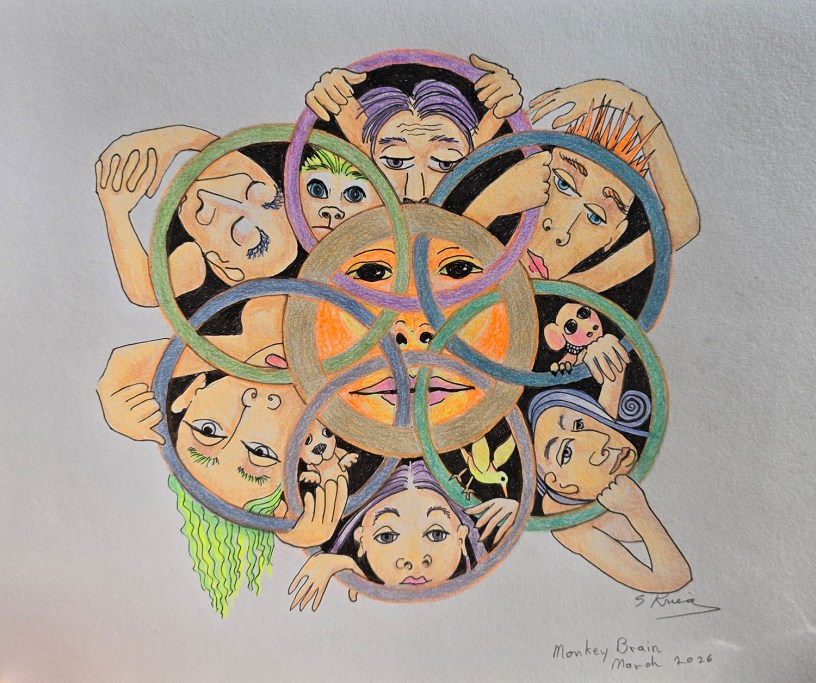
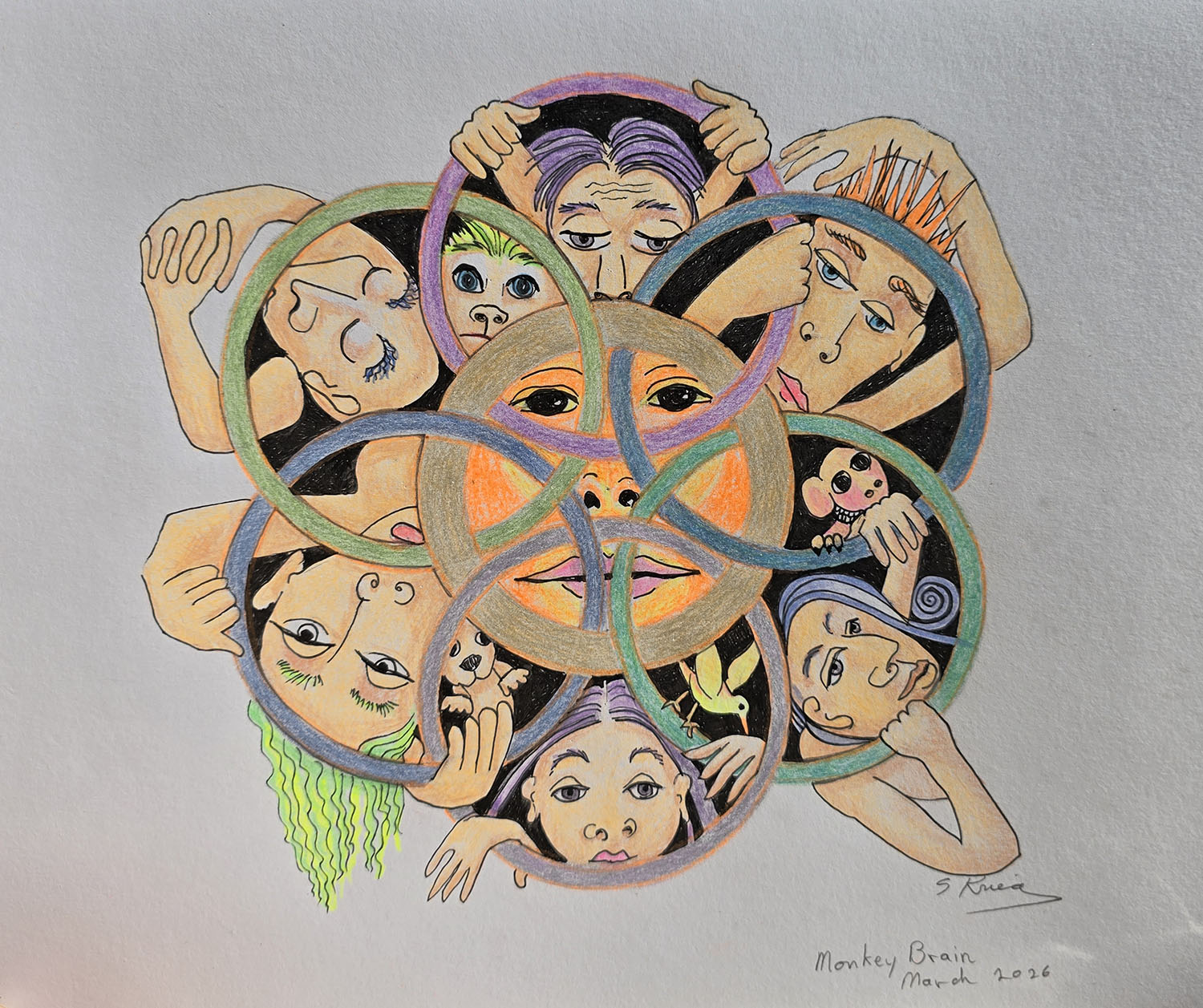
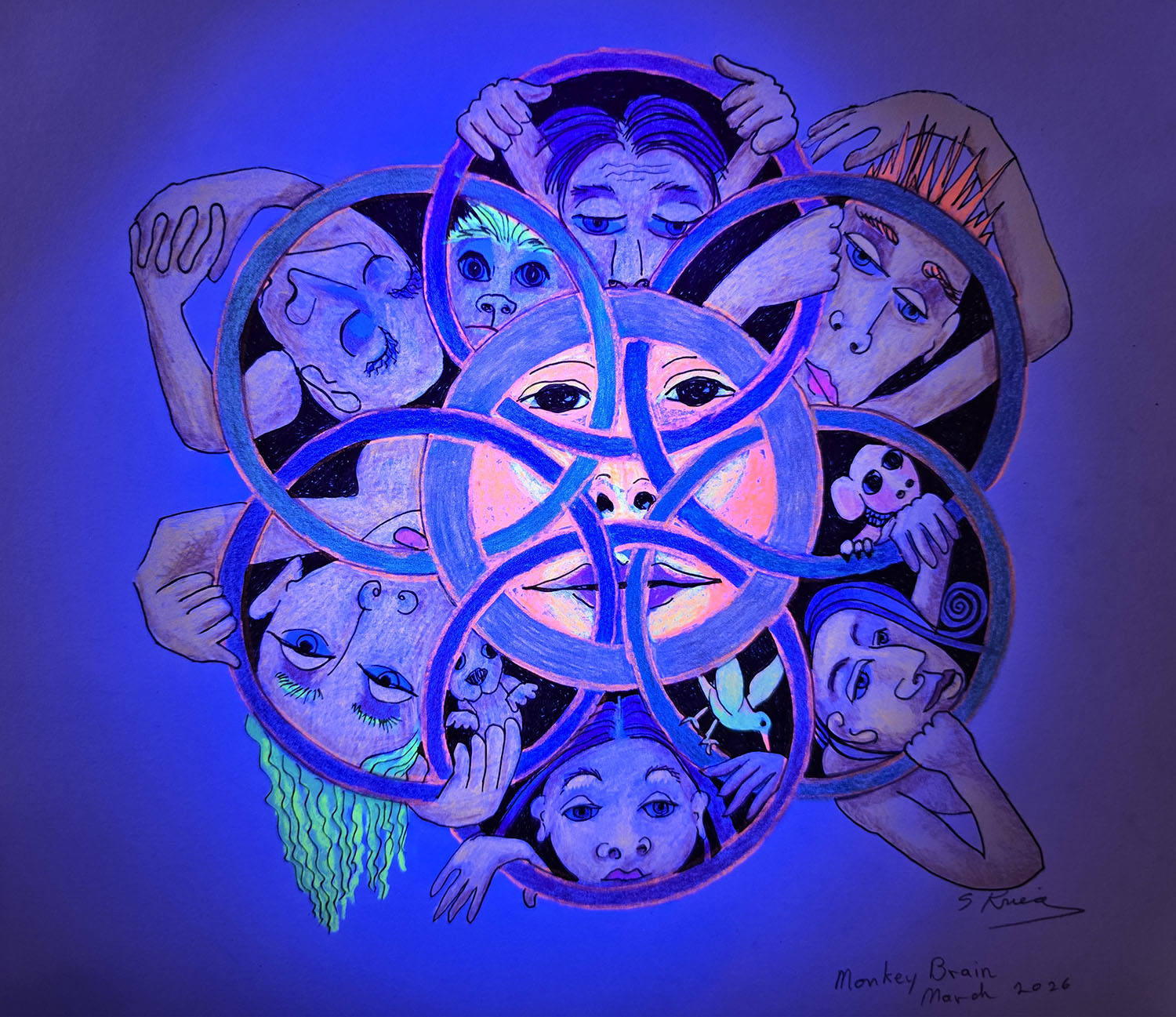
For this post , I have two images. The drawing under normal lighting and under black light. You can look at this right off and come to your own conclusions. Normally, I don’t go into great detail with the “weird” thoughts that go through my head while I’m drawing. But, on this occasion, their development followed a definite sequence and I want to share. Read on if that is of interest.
There are many things going on in preparation for my upcoming move to Asheville, NC. During February I was determined to get my stuff out of storage and into my apartment for the movers. This occurred during a major snow and ice storm that blocked the parking lot and made moving stuff difficult. My dog is recovering from her pancreatitis. I try to keep my daily breathwork and meditation going. Most importantly I am determined to keep up my by-monthly posting of my latest drawings on this blog. I’ve minimized the materials I have available for the next few months. I’ve also minimized the notebook size to draw in. All other materials are now packed and waiting for the move date.
I began the drawing, attempting to figure out the geometric process behind interlacing circles. I started with one circle. I divided it into six equal portions. Then I used the dividing points to draw six circles around it. After that I erased the lines that allowed the circles to look like they were intertwined with each other. This basic image reminded me of various symbols I’ve seen. It looked like a Celtic knot. It also resembled the Olympic logo of rings, representing the 5 inhabited continents. I realized that what I had unintentionally drawn was a symbol I’ve seen before called ‘The Seed of Life’. Google’s AI definition is that The Seed of Life is a sacred geometry symbol. It is composed of seven overlapping circles. These circles represent the seven days of creation. It symbolizes the origin of existence, harmony, and the interconnectedness of all life. You can also observe the oblong shape that the overlapping circles create. It is called a ‘Vesica Piscis’. Vesica Piscis means fish bladder symbolizing the union of opposites, divine creation and the intersection of spiritual and physical realms.
I believe most geometricians (a student of geometry) would be happy to leave the geometry at that and move on. The more I looked at it, I saw separate little cells – little cubby holes. It also reminded me of my gymnastic days as a little kid looking at monkey bars. I wanted to grab hold of the bars and start swinging! And so I did. I spontaneously drew with pen and ink the figures holding onto the bars within each cell of the circles.
I began coloring in the circles and faces. I remembered studying George Ivanovich Gurdjieff and the Fourth Way. He was an Armenian-Greek mystic and spiritual teacher around (c. 1890-1912). One of Gurdjieff’s teachings was that “man” has no unified “I.” Instead, “man” is a collection of fragmented, shifting “small I-s.” These are driven by mechanical habits, moods, and external stimuli. During my time in a Fourth Way Group, we were to refer to ourselves as “One” rather than “I”. For example “One wishes to eat” or “One thinks of an old memory.” All the while, One would notice the many “I”s in One’s head. They swirl around with thoughts like: I am hungry. I want to buy that object. I wonder how my mom is. What am I doing later? I, I, I, I. This is still so true if you make an effort to track what your mind is thinking. You will see a bunch of “I”s. To me my drawing now looked to me like a brain with many “I”s.
I kept coloring in the circles and the figures with metallic and neon pencils. I liked the softness of the metallic and the boldness of the neon. My brain jumped to thoughts of the workings of the ego. Here Google AI explains that the ego is the conscious “I.” It manages reality by balancing primal desires (id) with moral constraints (superego). It operates as a protective mechanism, establishing identity, maintaining self-esteem, and filtering information based on past experiences. Here again it seems the brain jumps around from one thought to another. I think to myself perhaps I’ve drawn an example of my inner egoic thoughts.
Then another thought, shelved in some corner of my head, jumps into play. Maybe this is the humunculus in my head!!! Popularized in 16th century alchemy and 19th century fiction, a homunculus is a tiny fully-formed person. It is thought to live in one’s head serving as powerful antagonists who embody vices and drive conflict. I recall the homunculus characterized in cartoons as a devil on one shoulder and an angel on the other.
Looking again at my now finished drawing, I see that the face in the center looks quite monkey-like. I decide to title the drawing ‘Monkey Brain.’ Google’s AI explains: Just like the ceaseless swinging of a monkey from branch to branch, our minds can leap from one thought to another. Our minds can rapidly flit between different thoughts, emotions, and impulses, often leading to anxiety and stress.
This metaphorical model refers to the limbic system (paleomammalian brain), which handles emotions, memory and anxiety. The limbic system consists of the amygdala, hippocampus, and hypothalamus. It describes a restless, distracted or emotional state. This specifically refers to the tendency to jump from one thought to another.
The universe gives me a final gift. I happen to turn on and listen to a teaching by my favorite guru, Anand Mehrotra. He established The Sattva Yoga Academy in the Himalayan foothills of India. Anand mentions ‘Monkey Mind.’ and points out the flitting nature of the lower “monkey mind”. Then he reminds us of the other representation of the human monkey. That being ‘Hanuman”. Hanuman is a revered Hindu deity. Hanuman is not only the devoted companion to Rama, he is an “aspect” of Rama. This aspect of consciousness is inside all of us and embodies unwavering devotion, immense strength, courage and selfless service.
This monkey business of consciousness is what make us (hanuman) human. We have both the lower monkey-mind brain and the higher consciousness capacity of the brain.
I am satisfied that I have created a fair representation of my brain on art today.
Susan Krieg
 susan krieg
Looks like a great piece for a mural.
Best,
Preston
LikeLike